
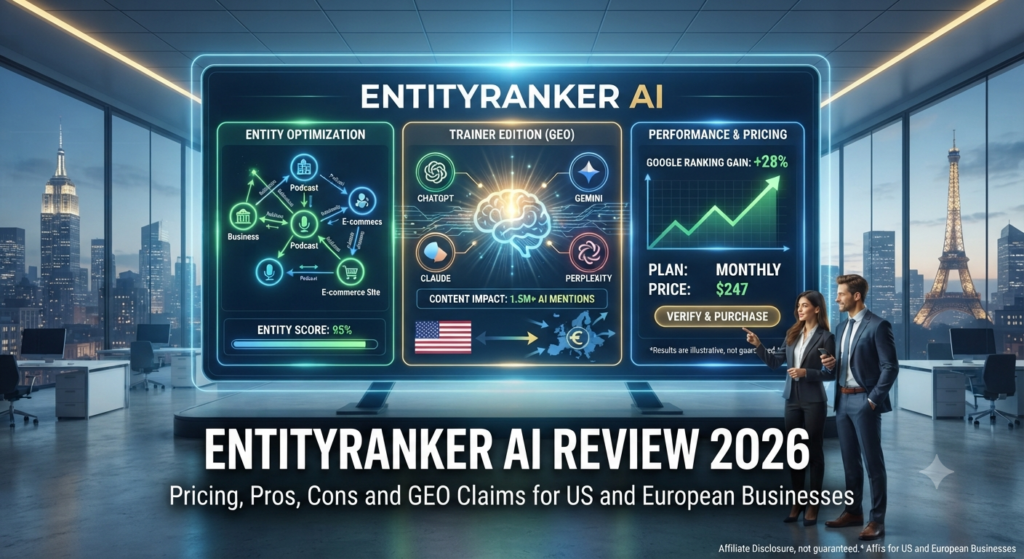
EntityRanker AI Review 2026: Pricing, Pros, Cons and GEO Claims for US and European Businesses
If you are comparing AI SEO tools for a business in the United States or Europe, the questions that matter most are usually practical: What does the software actually do? How much does it cost? Are the claims realistic? How are business and customer data handled? Does it suit a small business, agency, or larger team? And can it help with both traditional Google visibility and the growing interest in AI-search visibility?
This guide reviews EntityRanker AI, a software product created by Peter Drew and sold through JVZoo. It explains the product’s entity-based SEO positioning, its Trainer Edition, its GEO-related claims, pricing structure, limitations, and the questions buyers should answer before purchasing.
Affiliate Disclosure: This article contains affiliate links. If you purchase EntityRanker AI through one of our links, we may earn a commission at no additional cost to you. Our opinions are based on the information available at the time of writing, and an affiliate relationship does not guarantee a positive review.
Quick Answer
EntityRanker AI is presented as an SEO software created by Peter Drew and sold through JVZoo. The product website positions it around entity-based SEO, semantic content optimization, automated website or content creation, and insights that it says are based on leaked Google API documents.
Its Trainer Edition adds a GEO-related angle. The product website describes this upgrade with language about training models, influencing answers, and creating content that can be digested, remembered, and echoed by AI language models. This makes the product relevant to businesses interested in both traditional Google visibility and AI-search visibility.
However, these are product-positioning and marketing claims, not guaranteed outcomes. EntityRanker AI cannot guarantee Google rankings, AI citations, ChatGPT mentions, Gemini visibility, Google AI Overview inclusion, or control over how independent AI systems answer questions.
The realistic way to evaluate the product is as an SEO and content-structuring tool with a GEO-oriented feature set. Buyers should verify the current price, plan limits, refund policy, support terms, language support, data handling, and exactly what the Trainer Edition includes before purchasing.
👉 Check the current EntityRanker AI offer here
What Is EntityRanker AI?
EntityRanker AI is presented on its website as an SEO software product created by Peter Drew. JVZoo is shown as the retail or checkout platform used to sell the product.
The product website promotes EntityRanker around entity-based SEO, semantic content, Google Sites, Google Business Profiles, and insights it says are drawn from leaked Google algorithm or API documents.
This description reflects how the product is marketed. It should not be interpreted as proof that the software has access to Google’s current ranking system, can reproduce Google’s algorithm, or can guarantee a specific position in search results.
What Is Entity-Based SEO?
Entity-based SEO organizes content around clearly defined topics, entities, and relationships instead of relying only on repeated keywords. An entity may be a person, company, product, place, service, or concept.
The goal is to make the subject and its relationship to related topics clearer for readers and search systems. In practice, that can involve consistent descriptions, related concepts, supporting content, internal links, structured information, and accurate references.
Entity-based SEO can be a useful content-organization approach, but it does not replace content quality, technical SEO, topical relevance, authority, user satisfaction, or reliable information.
What Is GEO?
GEO usually means Generative Engine Optimization. It is a broad term used for improving how information may be discovered, understood, summarized, mentioned, or cited by generative AI systems.
GEO is not the same as directly training ChatGPT, Gemini, Claude, Perplexity, Google AI Overviews, or another independent AI system. Website owners generally cannot directly control the training data, retrieval system, update schedule, model behavior, or answers of those platforms.
Google’s official guidance says that existing SEO fundamentals remain relevant for AI features in Google Search. Google also says that special AI files, special schema, or separate technical markup are not required for appearance in AI Overviews or AI Mode.
If you want a deeper breakdown of what actually influences AI citations, we cover it in more detail in how to get cited by ChatGPT and Google AI Overviews.
What Does the Trainer Edition Claim?
EntityRanker’s Trainer Edition is described on the product website as a 2025 upgrade connected to AI language models. Its promotional wording focuses on training models, influencing answers, and creating content intended to be digested, remembered, and echoed by AI systems.
For a US or European business, the practical interpretation may be that the software helps organize brand information, product information, entity relationships, FAQs, and supporting content in a way intended to improve machine understanding.
The Trainer Edition should not be described as a guaranteed system for directly training or controlling third-party AI models. A more accurate description is that it is marketed as a GEO-oriented content and information-structuring feature.
Before buying, ask the vendor:
- Which AI platforms does the Trainer Edition specifically support?
- Does it create content only, or does it also publish and distribute content?
- How does it measure AI visibility?
- Does it track citations, brand mentions, or AI responses?
- Can users edit and approve the generated information?
- What happens if an AI platform does not use or cite the content?
- Are there limits on projects, languages, generated content, or usage?
- Does the feature require any additional subscription or upgrade?
What About the Leaked Google API Documents?
The EntityRanker website says that the software uses insights from leaked Google API or algorithm documents.
In May 2024, a large set of documents described as internal Google Search API documentation was publicly circulated and analyzed by the SEO industry. Those documents became an important source of discussion around possible search-system components and ranking-related concepts.
However, the documents were not official public Google ranking guidance. Google did not confirm that every documented field is used in the way SEO practitioners interpret it, nor that the materials describe the complete current ranking system.
EntityRanker’s use of those insights should therefore be treated as a proprietary methodology or marketing claim, not as proof that the software meets Google’s ranking requirements or can reproduce Google’s algorithm.
How EntityRanker AI May Work
The product is positioned around a guided SEO workflow in which users provide project details, keywords, business information, and other inputs. The software is then marketed as helping create content or website assets organized around entity and semantic relationships.
The exact workflow, output controls, publishing options, project limits, supported languages, and editing requirements should be confirmed inside the current product dashboard or official sales material.
Generated content should be reviewed by a human before publication for:
- Factual accuracy.
- Brand accuracy.
- Search intent.
- Regional relevance.
- Privacy and compliance.
- Grammar and readability.
- Unsupported claims.
- Duplicate or repetitive information.
- Unnatural wording.
- Misleading promises.
Key Features
| Feature | What the Product Website Claims | Practical Interpretation |
|---|---|---|
| Entity-based SEO | Content is structured around entities, topics, and relationships | May help organize topical content more clearly |
| Semantic keyword integration | Related terms and contextual language are used in content | Can reduce dependence on exact-match keyword repetition |
| Leaked Google API insights | The product says its approach uses insights from leaked Google API documents | Treat this as a product claim, not official Google guidance |
| Automated content or site creation | The software is positioned around creating SEO-focused content or sites | Verify output quality, editing needs, and publishing controls |
| Trainer Edition | Content is marketed as being processed and remembered by AI language models | Related to GEO and AI visibility, but does not guarantee AI citations |
| Google Sites or Business Profile positioning | The website mentions Google Sites and Google Business Profiles | Verify the current workflow, limits, and policy compliance |
| Multi-language support | The product promotes use across different languages or markets | Verify supported languages and output quality before relying on it |
| Support and updates | Support and ongoing updates are promoted as included | Confirm the exact terms for your selected plan |
USA Considerations
For a US-based business or marketer, the most practical questions are:
- What is the total cost in USD?
- Does the tool save time compared with manual content production?
- Does it work for a solo operator or small team?
- Can the content be edited before publication?
- Does it support local SEO and Google Business Profile workflows?
- Are there project, site, keyword, or content-generation limits?
- Does the output match US spelling, language, and customer expectations?
- What happens after the monthly or yearly payment renews?
- Is the time saved enough to justify the cost?
A US buyer should compare the subscription against realistic alternatives, including an SEO writer, a general AI writing tool, an agency workflow, or a manual content process.
Europe Considerations
European buyers should check additional issues before subscribing:
- Is the price shown in USD only?
- What is the final EUR or GBP amount at checkout?
- Is VAT included or added separately?
- Where is customer and project data stored?
- Is there a privacy policy and data-processing information?
- Does the vendor provide GDPR-related documentation?
- Are there regional restrictions for EU or UK customers?
- Is customer support responsive outside the United States?
- Does the software support the languages required for the target market?
- Are local currencies, local search behavior, and local regulations considered?
- What are the refund and cancellation terms?
- Does a one-time purchase include future updates and support?
Do not assume that a product is GDPR-compliant simply because it is available to European buyers. If GDPR or data processing is important to your business, request written confirmation from the vendor before purchasing.
Pricing
EntityRanker AI is available through different payment options, but this review focuses only on the $247 offer shown on the checkout page. The checkout indicates that this is a monthly license, so buyers should not treat it as a one-time payment unless the final checkout page clearly states otherwise.
Before purchasing, confirm the current $247 price, recurring billing or renewal terms, applicable taxes, refund policy, cancellation process, access period, support, updates, and whether the Trainer Edition is included. Prices, offers, and payment terms may change, so verify the final details directly on the official checkout page.👇
Note: The $247 amount is presented as a monthly offer. Confirm the final total and billing frequency at checkout before completing your purchase.
👉 See the current EntityRanker AI pricing and coupon status here
Pros and Cons
Pros
- Built around entity and semantic SEO rather than only generic AI writing.
- Offers a GEO-related Trainer Edition angle.
- The product positioning is more specialized than a basic text-generation tool.
- May be useful for agencies or marketers producing content at scale.
- May be accessible to users without advanced technical SEO skills.
- Multi-language positioning may be relevant for European markets.
Cons
- No SEO software can guarantee Google rankings.
- No software can guarantee ChatGPT, Gemini, Claude, Perplexity, or Google AI Overview mentions.
- The leaked-document positioning is not the same as official Google guidance.
- The product website’s claims should be independently evaluated.
- EUR pricing, VAT, GDPR, and data-handling details may require confirmation.
- Entity-based SEO does not replace technical SEO, authority, quality, links, or user satisfaction.
- Pricing may be high compared with general-purpose AI writing tools.
- Generated content may require fact-checking, editing, and regional adaptation.
- The exact Trainer Edition capabilities should be confirmed before purchase.
Who Should Consider It?
EntityRanker AI may be worth considering for:
- Agencies producing SEO content for multiple clients.
- Marketers who want an entity-focused content workflow.
- Businesses already familiar with basic SEO.
- Teams that can review and edit generated content.
- Users interested in testing a GEO-related content approach.
- Businesses that can measure results over time rather than expecting immediate rankings.
- Teams that understand the difference between SEO content structure and direct control over AI responses.
Who Should Skip It?
Consider skipping or postponing the purchase if:
- You expect guaranteed Google rankings.
- You expect guaranteed ChatGPT, Gemini, Claude, Perplexity, or AI Overview citations.
- You want a completely hands-off publishing system.
- You do not have time to fact-check and edit generated content.
- You are a new blogger with a very limited content budget.
- You need confirmed GDPR documentation before using any software.
- You need clear EUR pricing and the checkout does not provide it.
- You need detailed independent testing before making a purchase.
- You want a tool focused only on AI citation tracking.
- You have not yet built basic website quality, topical relevance, internal linking, and technical SEO.
For a lower-cost starting point, compare the software with general AI writing tools, specialist SEO platforms, freelance writers, or a manual content workflow before committing to a high-priced plan. Our review of an AI tool for writing and publishing SEO content automatically covers a more general-purpose, lower-cost alternative worth comparing first.
How It Compares With Other Tools
EntityRanker AI appears to target a narrower combination of entity-based SEO, semantic content, and GEO-related positioning.
A general AI writing tool may be cheaper and more flexible but may not include the same entity-focused workflow. A traditional SEO platform may offer stronger keyword, backlink, competitor, or technical-analysis features. An AI-visibility platform may focus on tracking mentions and citations rather than generating SEO content. For a broader look at AI-driven business automation beyond SEO content specifically, our SmartAgentX review is a useful comparison point.
Choose according to your actual goal:
| Main Goal | Tool Category to Compare |
|---|---|
| Create general articles | AI writing platform |
| Research keywords and competitors | Traditional SEO platform |
| Build entity-focused content | Entity or semantic SEO tool |
| Track AI mentions and citations | AI visibility monitoring platform |
| Automate wider business workflows | Business automation platform |
| Produce expert content | Specialist writer or SEO agency |
Frequently Asked Questions
Can EntityRanker AI guarantee Google rankings?
No. No SEO software can guarantee a specific Google ranking position. Rankings depend on competition, content quality, site authority, technical SEO, links, user satisfaction, search intent, and Google’s changing systems.
Entity-based optimization may support a content strategy, but it is not a guaranteed ranking method.
Is the leaked Google API documents claim legitimate?
The 2024 Google API document leak was a real event discussed extensively by the SEO industry. However, the documents were not official public Google ranking guidance, and Google did not confirm how every documented field is used in live search.
EntityRanker’s reference to those documents should therefore be treated as a product-positioning claim rather than proof of access to Google’s ranking algorithm.
Can the Trainer Edition directly train ChatGPT or Gemini?
Do not assume that it can directly train, upload data to, or control ChatGPT, Gemini, Claude, Perplexity, Google AI Overviews, or other independent AI systems.
The more cautious interpretation is that the feature is designed to help users create and distribute structured information that AI systems may be able to discover and understand. Actual visibility depends on each platform’s data sources, retrieval systems, model updates, policies, and content-quality signals.
Is EntityRanker AI a GEO tool?
The Trainer Edition is marketed with a GEO-related purpose, so it can reasonably be described as a GEO-oriented feature. However, GEO is a broad industry term and does not guarantee AI citations, mentions, or control over AI-generated answers.
Is pricing available in EUR for European buyers?
The product pricing is presented in USD in the available sales material. European buyers should confirm the converted amount, VAT, payment processing charges, and final checkout total before purchase.
Does EntityRanker AI comply with GDPR?
The product page should not be treated as proof of GDPR compliance unless it provides appropriate privacy and data-processing documentation. If GDPR is a requirement, contact the vendor and request written information about data storage, processing, subprocessors, retention, deletion, and user rights.
Is the $247 EntityRanker AI price a one-time payment?
The available checkout information presents the $247 offer as a monthly license, not a confirmed one-time payment. Buyers should verify the billing frequency, renewal terms, cancellation process, refund policy, access period, and Trainer Edition inclusion on the checkout page before purchasing.
Is EntityRanker AI suitable for a small business?
It may be suitable for a small business that can review the output and justify the cost through content production or time savings. It may not be suitable for an early-stage business with a limited budget or unrealistic expectations about instant rankings.
Does Google require special GEO markup or AI files?
Google’s official guidance says that special AI files, special schema, or separate markup are not required for Google AI features. Standard SEO fundamentals, helpful content, crawlability, internal links, visible text, good page experience, and accurate structured data remain important.
Review Method and Disclosure
This review is based on the product website, available sales information, and checkout details visible at the time of writing. It is not an independent long-term test unless a separate testing process is described.
The product’s features, pricing, discount codes, support terms, refund policy, data handling, language support, and access conditions may change. Always verify current information on the official product and checkout pages before purchasing.
Final Recommendation
EntityRanker AI may be worth considering for marketers, agencies, and businesses that want an entity-focused SEO workflow combined with a GEO-related Trainer Edition.
Its strongest potential use case is for users who already understand basic SEO and want help creating structured, entity-focused content at scale. It may be less suitable for beginners who expect instant rankings, guaranteed traffic, guaranteed AI citations, or direct control over how independent AI systems respond.
Whichever way you lean, verify the current price, coupon status, refund policy, and Trainer Edition inclusions directly on the checkout page before purchasing — offers and terms on JVZoo listings can change without notice.
👉 Check the current EntityRanker AI offer and pricing here
Pricing, features, and promotional offers are subject to change. Always verify current details, including EUR pricing and VAT for European buyers, on the official checkout page before purchasing.


